
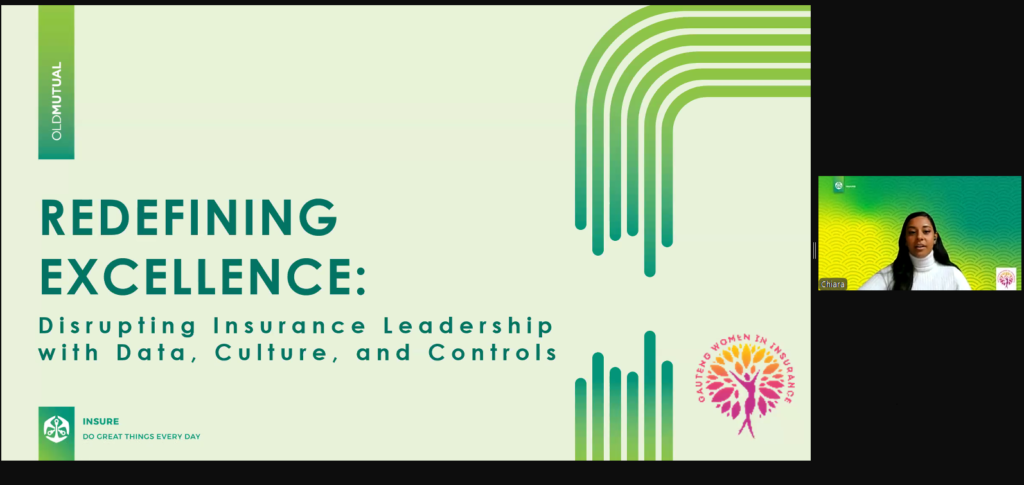
On 14 November, Gauteng Women in Insurance (GWII) held an insightful Continuous Professional Development (CPD) session, sponsored by Old Mutual Insure, where Chiara Ghirdari, Executive Head of Operational Excellence at Old Mutual, engaged attendees with a talk titled “Redefining Excellence: Disrupting Insurance Leadership with Data, Culture, and Controls.”
The session highlighted the evolving role of operational excellence in today’s insurance landscape and provided actionable insights into balancing data-driven strategies with cultural and leadership challenges.
The unique challenges of insurance leadership
Ghirdari began by acknowledging the industry’s distinctive environment, shaped by rigorous targets and relentless pressures. In her experience, “small businesses in this industry face massive targets” and operate within a complex regulatory landscape. This regulatory oversight, while necessary, often brings about resistance to change, which can hinder agility and innovation. For leaders in the insurance sector, navigating this landscape means balancing regulatory compliance with a vision for growth and transformation.
In her journey with Old Mutual, Ghirdari has encountered a “unique culture forged by pressures unlike other parts of the industry.” She emphasised that this cultural uniqueness is both a challenge and an asset. Leaders, she noted, must learn to leverage this distinctiveness by fostering an environment that encourages adaptability while honouring the established values of the organisation.
Data strategy to drive operational excellence
A key part of Ghirdari’s presentation centred on data strategy as a cornerstone of operational excellence. She highlighted how data, when leveraged effectively, can provide insights that enable better decision-making, improve customer experience, and drive efficiencies across operations. However, Ghirdari cautioned that data strategy isn’t just about collecting information; it’s about translating data into actionable insights. Leaders, she advised, need to ensure that their teams are skilled in data literacy, fostering a culture where data is not only accessible but also meaningful to all stakeholders.
In her words, “Operational excellence isn’t achieved by simply implementing data-driven processes. It requires an intentional culture shift where data becomes part of the organisational DNA.” This approach calls for leaders to invest in technology, training, and tools that make data insights an integral part of every employee’s role, creating a culture of continuous improvement and informed decision-making.
The ‘cost to play’ and navigating resistance
A recurring theme in Ghirdari’s presentation was the concept of the “cost to play” - the effort and resources required to achieve excellence. For her, this includes not only financial investment but also the “buy-in” from team members who may be hesitant to embrace change. “There is always a cost to play,” she stated, explaining that organisations need to evaluate their readiness to undertake the sacrifices that come with transformation. These sacrifices might include time, focus, and even a restructuring of certain roles to align with new objectives.
One of the biggest costs Ghirdari identified was resistance. Resistance, she explained, can come from many sources - regulatory hurdles, cultural inertia, or individual reluctance to adapt to new methods. For leaders, managing this resistance is crucial. Ghirdari urged leaders to “define the cost to play” clearly and address the barriers that could hold back their teams from achieving their full potential. This means understanding where resistance is coming from and working with empathy to transform hesitation into action.
A holistic approach to leadership
In redefining what it means to lead, Ghirdari advocated for a holistic approach to success, one that goes beyond metrics and targets. She introduced the idea of “wholistic wellness,” encompassing mind, body, and soul, and encouraged leaders to take care of themselves so they can better support their teams. Her emphasis on wellness underscores a shift in leadership thinking within the industry - away from purely output-driven results toward a focus on the well-being of individuals at all levels of the organisation.
This holistic view extends to the structure of leadership teams as well. Ghirdari believes in the power of collaboration, underscoring that “no great thing was ever achieved alone.” She encouraged leaders to build “fantastic teams” where members can shed the “dead weight” of outdated practices and work together toward shared goals. In doing so, she noted, leaders can create an environment where imperfect progress is celebrated, and every team member feels valued.
Leading with purpose and joy
Ghirdari’s presentation concluded with an empowering message for the attendees. She called on leaders to view themselves as “change makers, the center, the light in the darkness,” inspiring those around them by embodying the values they wish to see in their organisations. “Let us be the wave of excellence,” she said, “driving simplicity, tenacity, and focus while staying true to ourselves.”
Her call to action emphasised the importance of leading with both purpose and joy. For Ghirdari, achieving operational excellence is not merely about hitting performance targets; it’s about finding fulfilment in one’s work and encouraging others to do the same. By doing so, leaders can cultivate an environment where employees are motivated, resilient, and dedicated to contributing to a shared vision.
Transforming insurance leadership for the future
Ghirdari’s insights into data strategy, leadership, and culture provide a roadmap for professionals looking to make a lasting impact in their organisations. Her emphasis on balancing operational demands with a commitment to wellness and empathy sets a standard for a new kind of leadership - one that embraces both excellence and authenticity.
The session resonated deeply with attendees, inspiring them to think critically about their leadership practices and the kind of culture they want to create within their teams.