
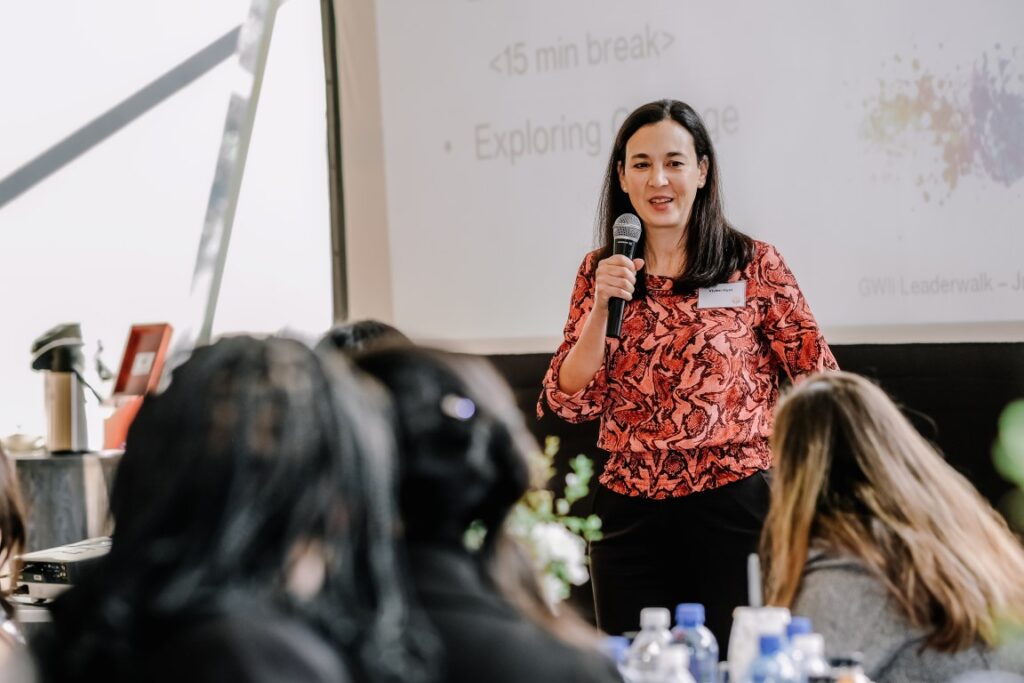
In collaboration with Business Engage and the 30% Club, Gauteng Women in Insurance (GWII) hosted a Leaderwalk on 8 June, with main sponsors Norton Rose Fulbright and Santam, and co-sponsors Garrun Group and Old Mutual Insure.
In this leaderwalk-themed Transformational Leadership, Vivien Hunt, a Leadership and Executive Coach unpacked what shifts leadership from transactional to transformational and explored two fundamental building blocks that unlock transformation, namely trust and courage.
A transformational versus transactional leader
The primary difference between these two leadership approaches, according to Hunt, is how they achieve results.
“A transactional leader uses extrinsic motivation to motivate individuals to work harder by offering rewards (or punishment) for performance and behaviour. This leader is task orientated and solves problems as they arise. They are focused on effectiveness and control, using low-level exchanges (salary, bonus, incentives) to get results. They work within the confines of the existing culture and give individuals little authority. Some benefits of this leadership style are achievable short-term goals, clear structure, concise instructions and analytical performance,” she said.
“A transformational leader on the other hand is people orientated and uses intrinsic motivation to engage the whole person, valuing both the individual and the results. This leader is focused on creating positive change, sharing a vision, and developing the potential of individuals, using high-level exchanges (trust, commitment, support, protection, and acceptance) to get results. They anticipate problems before they arise and encourage creativity and new ideas. They empower and inspire individuals to become leaders themselves,” she added.
These approaches are not mutually exclusive and a leader may use either or both depending on the situation.
What shifts leadership?
What shifts leadership from transactional to transformational, Hunt says, is the courage to experiment and co-create, the courage to be creative, curious, authentic, and vulnerable, the courage to be guided by and role model one’s values, to put relationships before task, to have braver conversations and to consciously build trust and resilience.
“Shifting from command and control to humanizing work, transformational means investing in people (which includes attending to fears and feelings) and in the words of Brené Brown, “courageous, empathetic, connected leadership will forge the way forward”,” said Hunt.
Two building blocks that unlock transformation
According to Hunt, transformational leaders aim to develop others and create positive impact and long-lasting change. “They engage, empower, and challenge individuals to step into their potential and ultimately inspire followers to turn into leaders. They cannot do this without Trust and Courage, two essential skill sets for transformational leaders which can be taught and learned,” she said.
“Trust is needed for leaders to build psychological safety, empathy and connection. Trust must exist for individuals to feel a leader has their best interest at heart, that they are supported, and cared for, and that it is safe to experiment, take risks, and make mistakes. When individuals feel that they can trust, they can be more open to feelings of courage and vulnerability and more comfortable with change and uncertainty,” she added.
“Courage is the gateway to change. It is the place where we can access our heart’s energy and start to live and act with more awareness. It is a vulnerable place and requires continuous calibration for an individual to maintain oneself in this place referred to as ‘above the line’, as it is easy to be pulled back ‘below the line’ into hopelessness, fear, and frustration. Both leaders and followers need the courage to step outside of their comfort zone and develop self-belief, confidence, and the willingness to try new things,” she continued.
Three easy-to-apply tools
There are three tools that leaders can start using to positively impact change and transformation in their personal and professional life, according to Hunt, which are:
- Design the ways of working - one on one or in a group - have a design conversation to manage expectations and get clarity on what each person needs and is offering or can be relied on for. Design the experience you want to have and design how you want to be with each other when things go well and not so well. This tool is your starting point for braver conversations.
- T.R.U.S.T. - use these building blocks in every conversation to create a solid foundation of Trust:
- Transparency - be transparent about desired outcomes, quell threats or fears;
- Relationship - listen to connect, and build a relationship before moving to task;
- Understanding - listen to understand and seek common ground;
- Shared success - co-create a vision of shared success; and
- Truth-telling - close gaps and test assumptions.
- The seven levels of effectiveness - follow the stepping stones to courage, engagement, innovation, synchronicity (above the line), and understand how to move out of hopelessness, fear, and frustration (below the line). Use your seven levels as a check-in tool, asking where you are right now and where you want to be. Build awareness from which level you are choosing to act and speak.
In her concluding remarks on how leaders can be more effective, and transformational and make a more positive impact, Hunt said, “By designing ways of working, having braver conversations, asking for what you need, knowing and leveraging strengths, being present, building trust and courage, talking more about trust and courage, accessing and applying higher level resourcefulness (courage, engagement, innovation, and synchronicity) and by creating a regular practice of self-reflection and awareness.”
Ten people got a book, Multipliers, Revised and Updated: How the Best Leaders Make Everyone Smarter, by Liz Wiseman, sponsored by Genasys. Thank you, Genasys!
A discussion
We thank our table hosts (below) for accepting our challenge to facilitate discussions:
- Annelot Schrijver - Owner, Schrijver & Co
- Donald Dinnie - Director, Norton Rose Fulbright
- Lauren Anderson - Director, Yourinsurance Brokers (YiB)
- Lindiwe Matlou - Regional Manager, Santam
- Michelle Pringle - Managing Director, Garrun Group
- Phumzile Mnisi - Strategic Partnerships Manager, Old Mutual Insure
- Rethabile Shabalala, Senior Associate, Norton Rose Fulbright
In the feedback session, all the table hosts agreed with the comments that Hunt shared.
Thank you
Thank you to all the delegates who attended this event, we hope that the session inspired you, as a leader, to focus on elevating others, encouraging and inspiring individuals to innovate and develop new ways to grow and improve the path to future success.
Thank you to our main sponsors Norton Rose Fulbright and Santam, and co-sponsors Garrun Group and Old Mutual Insure for making this event possible.
See the photo album here